Peronospora considerations
Plasmopara viticola
Jan-20-2016
Peronospora considerations
Downy mildew is a fungus that requires specific climatic conditions to spread, determined, in particular, by rain and atmospheric temperature. These two factors alone can, through different combinations, provide a wide range of circumstances for which it is difficult to make predictions or hypotheses regarding the appearance of the parasite.
MANIFESTATION OF SYMPTOMS
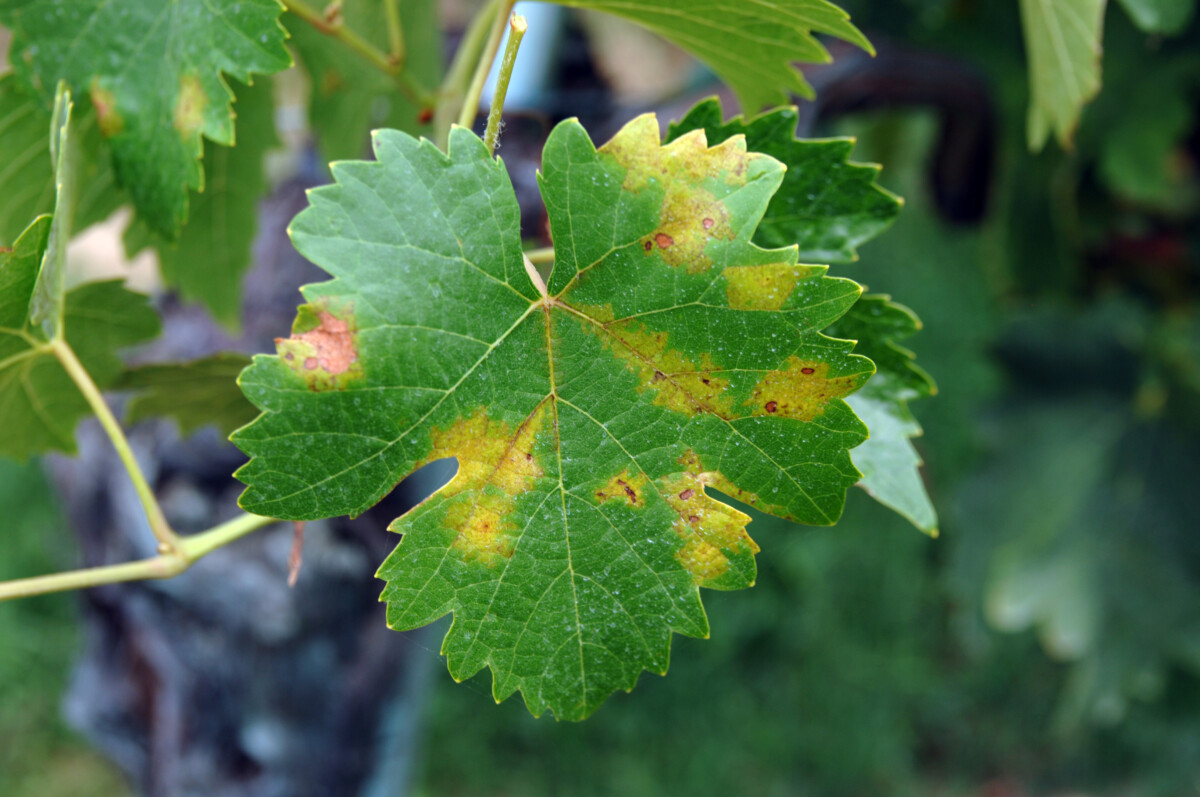
In addition to the spread of infections, even the ways in which symptoms appear may not be recurrent during the first infection. The oil spots can in fact be found on the vegetation closest to the ground, isolated, very large, with abundant mold on the underside of the leaf. In conditions of more arid environments, the spots can appear even in greater numbers, distributed at all heights of the row, smaller and free of mould.
Very important after the infection is the climate that follows. Beyond the obviously important treatments, the temperature and humidity of the air can be the basic factor for the massive spread, slowing down or stopping the infection.
Subsequently, in the vineyards characterized by microclimates favorable to the parasite, secondary infections start which progressively extend and intensify, always with a certain favor of the climate. The great concern is represented by the attacks on the bunches, especially during the herbaceous growth of the berries. The first attacks on the leaves and soft tissues can, in fact, be the premise of uncontrolled infections of the berries.
After the hot period of summer and with the help of new rainfall, the downy mildew, initially slowed down by the high temperature, resumes its activity, always affecting the green parts of the foliage.
In this case, however, the disease manifests itself differently. In fact, after a certain latency, when it resumes being more active, it finds herbaceous tissues of a completely different consistency, the vegetative arrest having now been defined. Also this other infection has so peculiar characteristics. The oil stains, in fact, can still be the typical spring ones if the new shoots at the top of the row are interesting. The most typical late summer manifestation takes the name of “mosaic downy mildew”, as on the now hardened tissues the fungus acts between the ribs even if only of a lower order. A mottling of angular shapes spreads among the younger but already hardened leaves. The infection can affect the entire flaps causing significant percentage desiccation in the upper part of the back.
PREVENTION AND RESULTS
The difference between the vineyards in relation to the care of the winemakers is evident at this time.
The correct phytosanitary defense and prevention in the spring period of greatest danger and diffusion provides appreciable guarantees of reaching the end of the year with healthy leaves and bunches, even in circumstances of greater danger.
On the other hand, in the more neglected vineyards, when the distribution of the scrub in mid-July affected both the new and old vegetation. It is probable that the “downy mildew” has spread on part of the bunches that are still green. The containment of this form is no longer possible and the disease proceeds both on the rachis and inside the berries leading to the final destruction of part or all of the affected infructescences.