The acid rot of the grapes
The acid rot of the bunches appears in the vineyards during the ripening
Jan-20-2016
The acid rot of the grapes
The acid rot of the bunches appears in the vineyards during the ripening. The infection spreads more and more as the phenological phase progresses. Its incidence depends on a multiplicity of factors, some of a physiological nature of the vine, others parasitic and finally, important as always, the climatic trend.
This disease was once believed to be the main consequence of the attacks of Tignole. The winegrowers fought the insects to preserve the harvest from this evil, which, at the time of the harvest, was certainly to be considered the most harmful.
Today, the advent of the Drosophila suzukii parasite has determined a further and consistent cause of the spread of the evil. In fact, the action carried out by the females for the deposition of the eggs and the numerous wounds consequent to these and also to the development of the larvae represent alleys that have perhaps become predominant at the present time. The physical condition of the bunches becomes the most effective prevention of the massive spread of the disease.
Symptoms
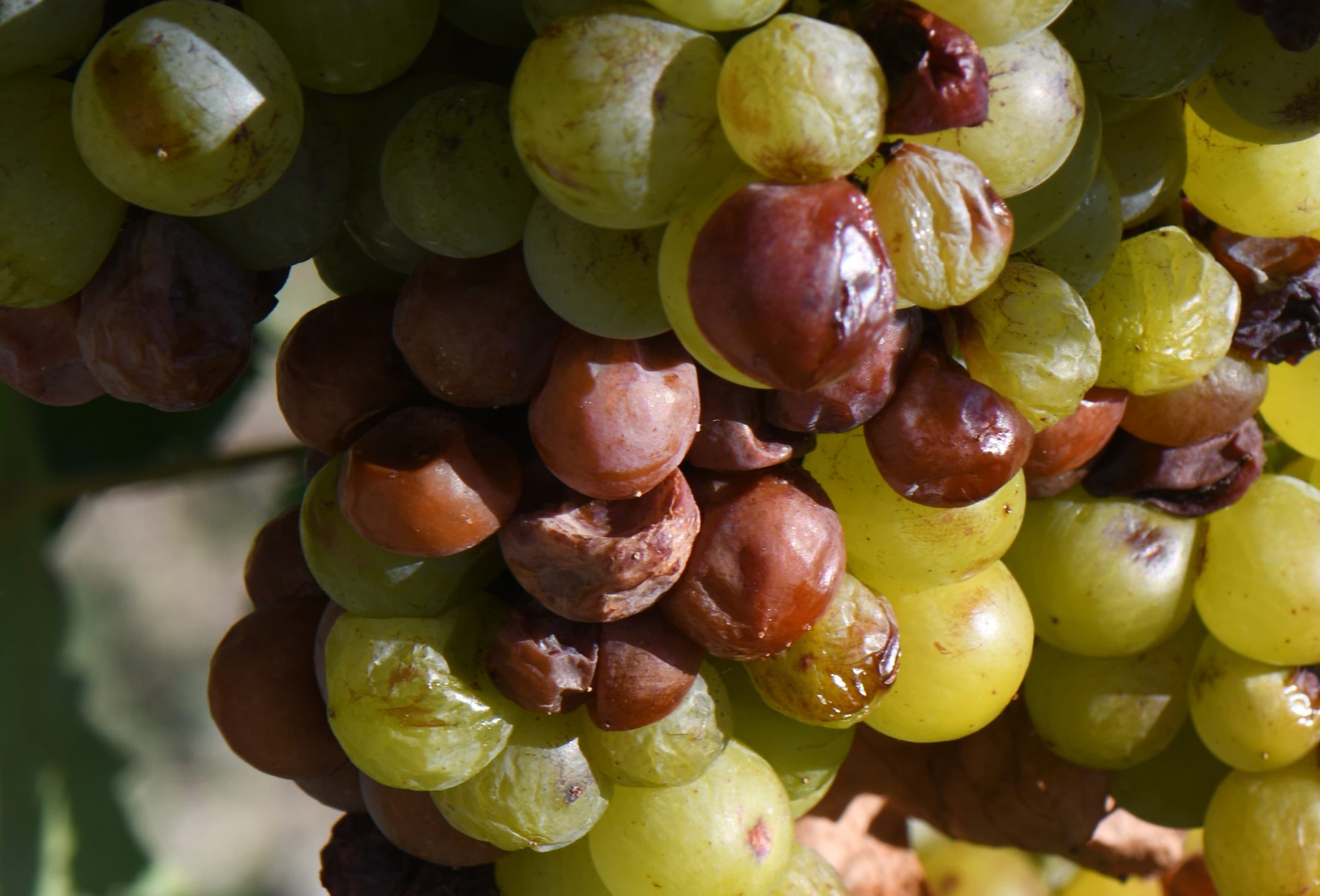
The first symptoms of acid rot can already appear at the beginning of veraison, or later, when the maturation is almost complete. In the central part of the bunches, starting from the pedicels, the berries become shiny and hazelnut-coloured. At first, the damage appears circumscribed and therefore contained. The infection subsequently expands, with different speeds, in relation to the years. The grapes remain, for a certain time, turgid, while the skins become fragile and tear. The juices contained dirty the remaining part of the bunch and thus favor the spread of other parasites. Some affected grapes appear emptied, while others undergo rotting phenomena. In correspondence with the bunches, vinegar flies can be seen flying over the affected grapes and their larvae. These insects, thanks to the continuous movement, favor the spread of the microorganisms that cause the disease: the acetic bacteria and some species of yeasts that have been identified on the diseased grapes.
Walking among the rows, the unpleasant smell of acid is clearly perceived.
The damage to production is under the aspects of quality and quantity. They are therefore fearsome.
Different pathogens
Acid rot is often accompanied by consistent gray mold infections, even though they are distinct diseases. Each of them has its own evolution and is independent of the other. However, both are favored by common factors, such as the adequate availability of water in the soil, the degree of compactness of the bunches and the reduced layer of wax that naturally covers the skins.
Other elements favorable to acid rot are: prolonged spring vegetative activity, excessive vigor of the shoots, larger size of the berries and any shady condition in which the latter may have developed.
Cultural prevention
To reduce the incidence of this evil it is important to adopt the most appropriate preventions.
Among the agronomic practices, fertilization is of great importance, since it must provide the plant with the entire nutritional requirement, without stimulating it to growth rates that are too fast. The contribution of mineral elements must therefore be defined on the basis of some characteristics of the vineyard, such as for example the age, the vine and the type of soil.
In particular, where there is a certain predisposition towards this evil, it is advisable to limit the nitrogen inputs.
Finally, foliar fertilization is an even more delicate choice. At the time of the herbaceous growth of the bunches, the administration of elements of immediate assimilation can cause unexpected effects to the plant. In vineyards at greater risk, where excessive shoot growth must be avoided, this type of nutrition should be limited only to cases of obvious necessity.
Another cultivation practice useful for prevention is green pruning. The essential condition is that the bunches can grow from the beginning of their formation, benefiting from a microclimate that favors their good development. After fruit set, the young grapes must grow not too sheltered from the leaves, in order to be able to strengthen and not suffer, later on, the trauma of sudden exposure to the sun’s rays. The operations of peeling and de-feeding must start in time, in order to guarantee the best environmental conditions for the fruit to develop, as evenly as possible. Still in the context of prevention, the uniformity of the bunches is a further essential element. The fruits most susceptible to infection represent, in fact, a serious danger to others.
Collection
At the harvest, the work of the winemaker ends with the strict selection of the bunches. Normally, when infections are present, it is advisable to carry out a preliminary selection, in order to subsequently facilitate the harvesting operations without incurring the risk of contaminating the healthy fruits.