Binding of rooted tying
Practice and type of pruning
Jan-20-2016
Binding of rooted tying
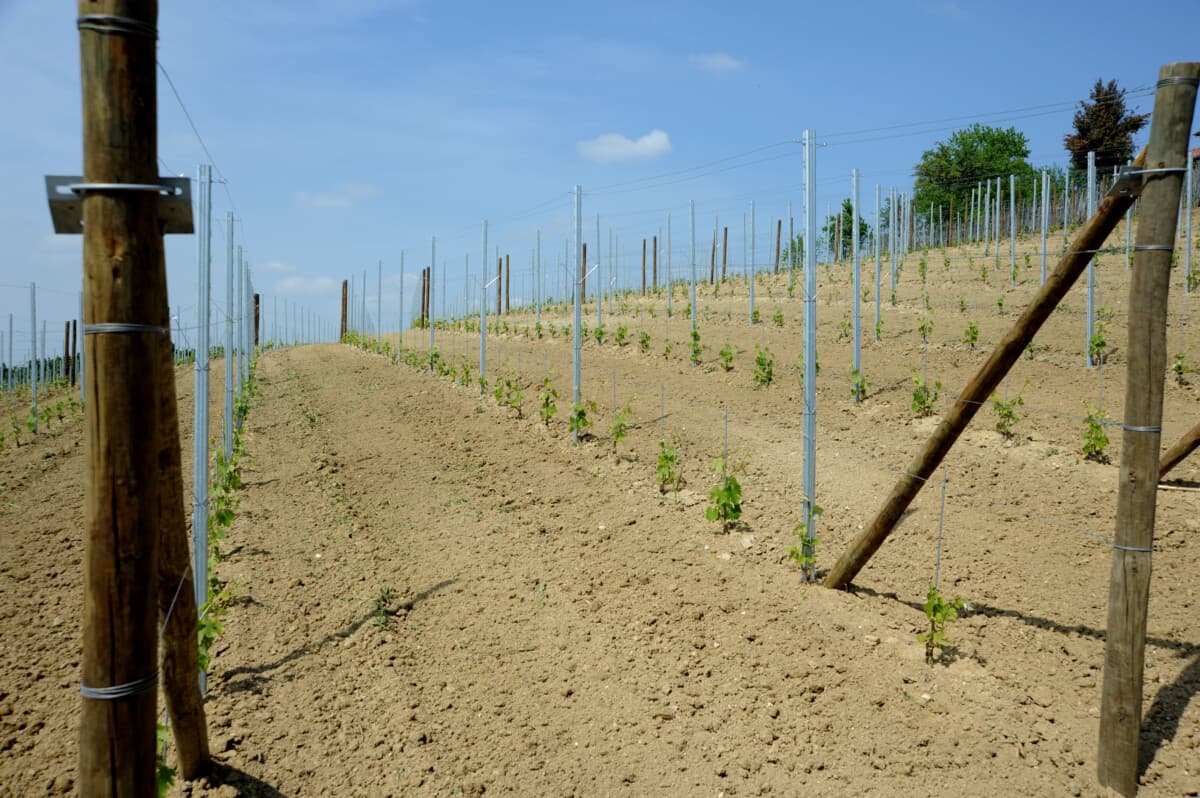
It is part of the ordinary breeding practice to tie the newly planted rooted stumps to the stakes, in order to educate them to the upright position with ties. Sometimes these are only provisional, available at the moment, with the purpose of their subsequent replacement, perhaps at the time of dry pruning. It happens that this does not always happen, especially when it comes to replacement seedlings in an old vineyard. Even more, when the tying takes place too close to the ground and therefore easily hidden by the earth or grass.
The tie
The traditional tie of the past was wicker, very functional since it provided an excellent seal with a permanence of about a year, before deteriorating naturally. Plastic materials, on the other hand, are indestructible, while those animated with thin metal wires maintain their effectiveness for many years. For these reasons, bindings with the latter materials should be inspected annually, to allow the stock to grow freely without damage, without the danger of engulfing the binding at the base.
In the event that the basal ligature, carried out at the time of young plant in breeding, has been hidden by the soil, the effects of suffering can manifest themselves after a few years.
Instead, in the case of subsequent tying after a well-developed stock, the time for the manifestation of symptoms corresponds to that necessary for the further and significant enlargement of the stem.
The bottleneck
When the tie starts to tighten, something peculiar happens. The woody structure grows every year with an additional peripheral layer. In a nutshell, it widens, not expanding but creating new structures. Peripherally, immediately below the bark, there is a particular tissue, very thin and more tender than the internal woody part. In it the substances elaborated by the leaves descend towards the parts that the plant has prepared as reserve places.
The progressive narrowing resulting from forgotten ligatures hinders this tissue and stops its specific function. The elaborates are thus unable to cross this barrier and an anomalous concentration is established in the parts above it. The green organs highlight this anomaly by taking on bright hues, very evident when the vine is red. If this binding involved only a part of the plant, the effects would be even more underlined by the comparison of the two different conditions within the same canopy.
The recovery of these plants is difficult, as the lesions are permanent and often already very serious at the time of recognition. Said recovery, never happens completely. Even if it were possible to debase the tie already partially incorporated in the wood, a deep trace remains that time will not erase. This last operation is possible only the following year in which the lesion began.
Future progression
The strain continues its development in the following years. After a couple of seasons, it is probable that the conspicuous symptoms, which previously appeared on the vegetation, will never reappear. The lesser functionality of the stem consists in the alteration of a part of the vessels. In the case of physiopathies of various kinds, and in particular the presence of the “Mal dell’esca”, the predisposition of the plants to suffering will be higher.
In the event that the binding has been entirely absorbed and is therefore no longer visible from the outside, the growth of the wood highlights the alteration with a particular enlargement, arranged in a ring around the entire circumference. This is the case of plants that have begun their suffering still in the juvenile period, during which the increase in diameter of the stem is relatively rapid. The resulting anomaly causes the mechanical resistance of the stem not to be proportionate to its size. Breakages will be possible in the vicinity of these swellings, perhaps determined by an accidental blow with a tool or by the action of the prolonged winter frost.